Cluster structure prediction
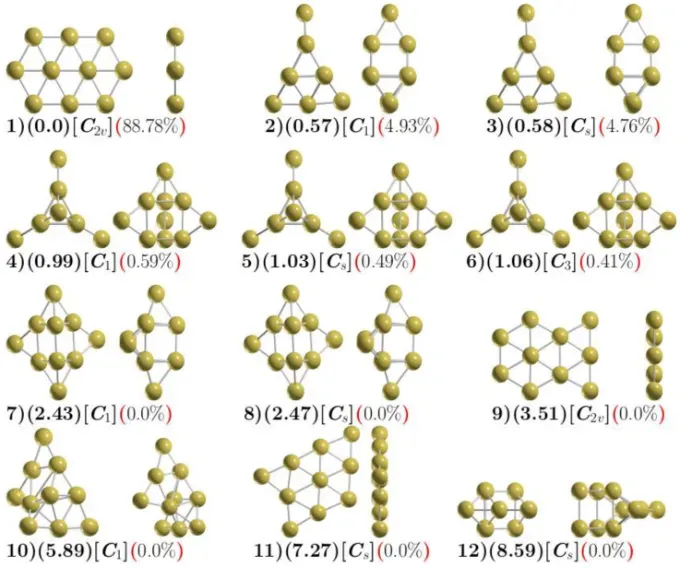
Global-minimum searches on the potential energy surfaces of atomic and molecular clusters using evolutionary algorithms coupled to density functional theory.
Area 03
Design and analysis of species with unconventional bonding, such as planar hypercoordinate carbons, molecular stars and tubular boron motifs.
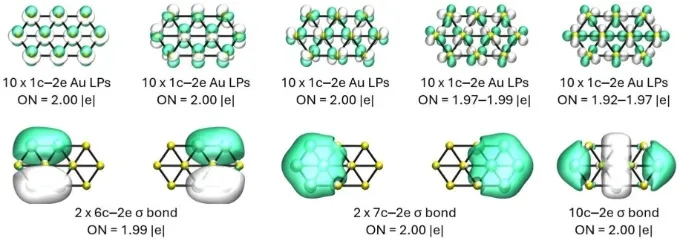
Some molecules defy the classical rules of bonding: carbons with four or five neighbours in a single plane, aromatic rings that include metals, or tubular boron structures. Understanding why they are stable makes it possible to design new species and propose them as experimental targets.
This line combines potential energy surface exploration with chemical bonding and aromaticity analysis tools (electron delocalization, natural orbitals and magnetic response) to explain the stability of these systems.
Much of this work has been carried out in collaboration with theoretical chemistry groups in Mexico, China and Latin America.
25 publications
Structure search for B7Mn2 clusters: Inverse sandwich geometry with a high-spin state
Computational and Theoretical Chemistry 1254, 115487 (2025)
Designing a Four-Ring Tubular Boron Motif through Metal Doping
Inorganic Chemistry 61(37), 14553–14559 (2022)
Hitting the Bull's Eye: Stable HeBeOH+ Complex
ChemPhysChem 23(23), e202200587 (2022)
Planar pentacoordinate carbon in CGa5+ derivatives
Physical Chemistry Chemical Physics 20(18), 12350–12355 (2018)
Structure and Bonding in CE5− (E = Al–Tl) Clusters: Planar Tetracoordinate Carbon versus Pentacoordinate Carbon
Chemistry – An Asian Journal 13(11), 1467–1473 (2018)
Revisiting the racemization mechanism of helicenes
Chemical Communications 54(2), 188–191 (2018)
Coaxial Triple-Layered versus Helical Be6B11− Clusters: Dual Structural Fluxionality and Multifold Aromaticity
Angewandte Chemie International Edition 56(34), 10174–10177 (2017)
E3M3+ (E = C–Pb, M = Li–Cs) Clusters: The Smallest Molecular Stars
Chemistry – A European Journal 23(47), 11430–11436 (2017)
Does H4SO5 exist?
Physical Chemistry Chemical Physics 19(26), 17088–17093 (2017)
Importance of Dispersion on the Stability of the Concave-Bound CpM (M = Fe, Ru, Os) Complexes of Sumanene
Organometallics 36(10), 2036–2041 (2017)
Planar pentacoordinate carbon atoms embedded in a metallocene framework
Chemical Communications 53(1), 138–141 (2017)
Structure and Bonding of Alkali-Metal Pentalenides
Organometallics 36(2), 310–317 (2016)
Why CpAl–Cr(CO)5 is linear while CpIn–Cr(CO)5 is not? Understanding the structure and bonding of the CpE–Cr(CO)5 (E = Group 13 element) complexes
Theoretical Chemistry Accounts 135(10) (2016)
Structure and bonding in WCn (n = 2–5) clusters
Theoretical Chemistry Accounts 135(9) (2016)
Microsolvation of NO3−: structural exploration and bonding analysis
RSC Advances 6(76), 71913–71923 (2016)
Breaking the Isolated Pentagon Rule by Encapsulating Xe2 in C60: The Guest Defines the Shape of the Host
ChemistrySelect 1(10), 2405–2408 (2016)
10-π-Electron arenes à la carte: structure and bonding of the [E–(CnHn)–E]n−6 (E = Ca, Sr, Ba; n = 6–8) complexes
Physical Chemistry Chemical Physics 18(17), 11909–11918 (2016)
The cubyl cation rearrangements
Chemical Communications 52(16), 3403–3405 (2016)
How Many Water Molecules Does it Take to Dissociate HCl?
Chemistry – A European Journal 22(8), 2812–2818 (2016)
How strong are the metallocene–metallocene interactions? Cases of ferrocene, ruthenocene, and osmocene
Physical Chemistry Chemical Physics 18(1), 550–556 (2016)
Planar tetracoordinate carbons with a double bond in CAl3E clusters
Physical Chemistry Chemical Physics 17(14), 8769–8775 (2015)
Planar pentacoordinate carbons in CBe54− derivatives
Physical Chemistry Chemical Physics 17(6), 4620–4624 (2015)
Ab Initio Study on the Stability of NgnBe2N2, NgnBe3N2 and NgBeSiN2 Clusters
ChemPhysChem 15(12), 2618–2625 (2014)
Exploring the Potential Energy Surface of E2P4 Clusters (E = Group 13 Element): The Quest for Inverse Carbon-Free Sandwiches
Chemistry – A European Journal 20(16), 4583–4590 (2014)
In Quest of Strong Be–Ng Bonds among the Neutral Ng–Be Complexes
The Journal of Physical Chemistry A 118(2), 487–494 (2013)
Global-minimum searches on the potential energy surfaces of atomic and molecular clusters using evolutionary algorithms coupled to density functional theory.
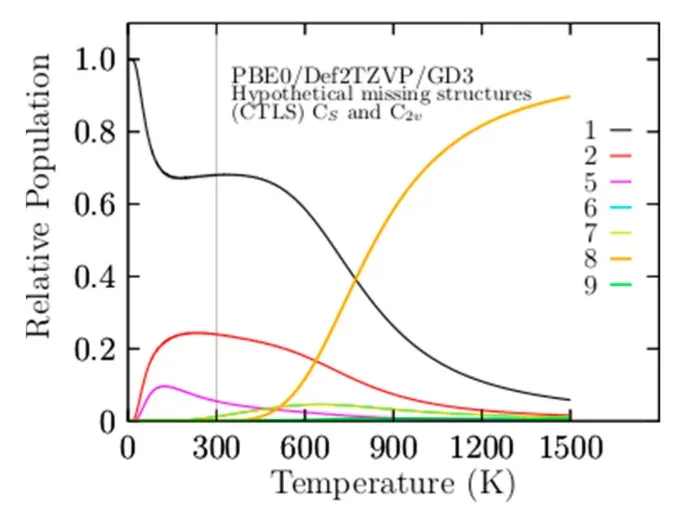
Free-energy surfaces, Boltzmann populations and temperature-dependent IR and VCD spectra that explain cluster fluxionality and chirality.
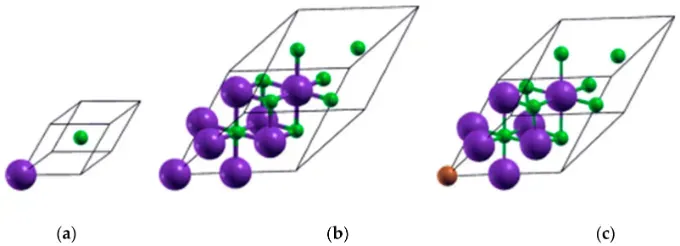
Linear and nonlinear optical response, band structure and thermoelectric properties of solids, surfaces and two-dimensional systems.