Cluster structure prediction
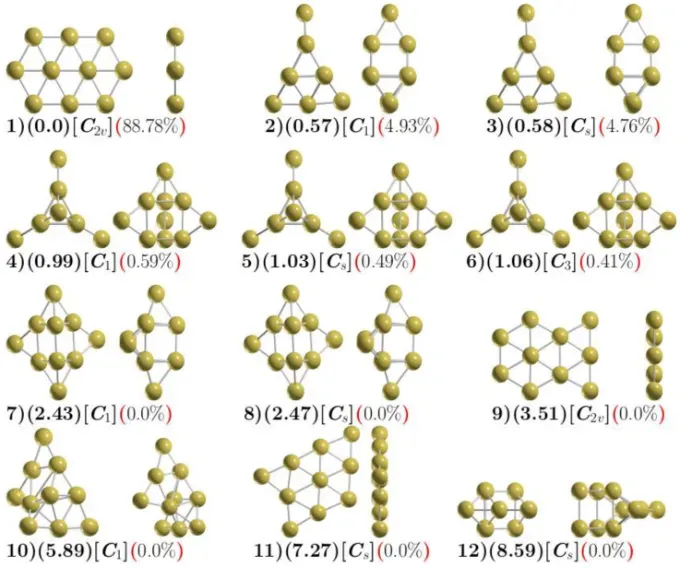
Global-minimum searches on the potential energy surfaces of atomic and molecular clusters using evolutionary algorithms coupled to density functional theory.
Area 02
Free-energy surfaces, Boltzmann populations and temperature-dependent IR and VCD spectra that explain cluster fluxionality and chirality.
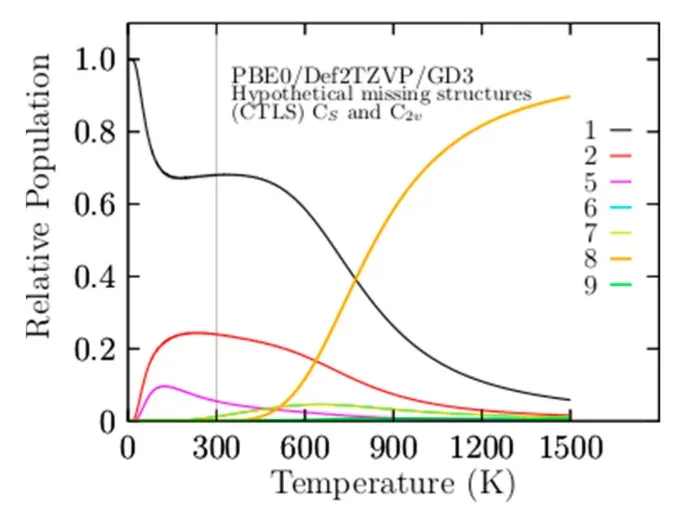
Most calculations describe molecules at 0 K, but experiments are carried out at finite temperature. At room temperature a cluster can be a mixture of isomers whose proportions change with temperature, and that changes what is observed in the laboratory.
This line builds free-energy surfaces from statistical thermodynamics and computes the Boltzmann populations of each isomer as a function of temperature. These populations are then used to average infrared (IR) and vibrational circular dichroism (VCD) spectra so they can be compared directly with experiments.
The approach has been applied to systems such as Au₁₀, Cu₁₃, Be₆B₁₁⁻ and Be₄B₈, and is complemented by ab initio molecular dynamics.
14 publications
Exploration of Free Energy Surface of the Au10 Nanocluster at Finite Temperature
Molecules 29(14), 3374 (2024)
The Role of Nitrogen-Rich Moieties in the Selection of Arginine’s Tautomeric Form at Different Temperatures
Acta Chimica Slovenica 70(4), 642–650 (2023)
PDF (opens external site)doi:10.17344/acsi.2023.8435 (opens external site)
Effects of Temperature on Enantiomerization Energy and Distribution of Isomers in the Chiral Cu13 Cluster
Prime Archives in Material Science (2022)Chapter
PDF (opens external site)doi:10.37247/pams4ed.4.22.16 (opens external site)
Thermodynamic Properties of Cu38 Cluster
Prime Archives in Chemistry (2022)Chapter
PDF (opens external site)doi:10.37247/pachem2ed.2.22.22 (opens external site)
Relative Populations and IR Spectra of Cu38 Cluster at Finite Temperature Based on DFT and Statistical Thermodynamics Calculations
Frontiers in Chemistry 10, 841964 (2022)
PDF (opens external site)doi:10.3389/fchem.2022.841964 (opens external site)
Boltzmann Populations of the Fluxional Be6B11− and Chiral Be4B8 Clusters at Finite Temperatures Computed by DFT and Statistical Thermodynamics
Density Functional Theory – Recent Advances, New Perspectives and Applications (IntechOpen) (2022)Chapter
Effects of Temperature on Enantiomerization Energy and Distribution of Isomers in the Chiral Cu13 Cluster
Molecules 26(18), 5710 (2021)
Effects of Temperature on IR Spectroscopy of the Fluxional Be6B11− Cluster
Prime Archives in Material Science (2021)Chapter
PDF (opens external site)doi:10.37247/pams2ed.2.2021.25 (opens external site)
Theoretical Prediction of Structures, Vibrational Circular Dichroism, and Infrared Spectra of Chiral Be4B8 Cluster at Different Temperatures
Molecules 26(13), 3953 (2021)
Effect of temperature on the structure of Pd8 and Pd7Au1 clusters: an ab initio molecular dynamics approach
Theoretical Chemistry Accounts 140(7) (2021)
Exploration of Free Energy Surface of Chiral Be4B8 Cluster at Different Temperatures
Prime Archives in Material Science (2021)Chapter
Exploration of Free Energy Surface and Thermal Effects on Relative Population and Infrared Spectrum of the Be6B11− Fluxional Cluster
Materials 14(1), 112 (2020)
Dynamical behavior of boron clusters
Nanoscale 8(40), 17639–17644 (2016)
Dynamical behavior of Borospherene: A Nanobubble
Scientific Reports 5, 11287 (2015)
PDF (opens external site)doi:10.1038/srep11287 (opens external site)
Global-minimum searches on the potential energy surfaces of atomic and molecular clusters using evolutionary algorithms coupled to density functional theory.
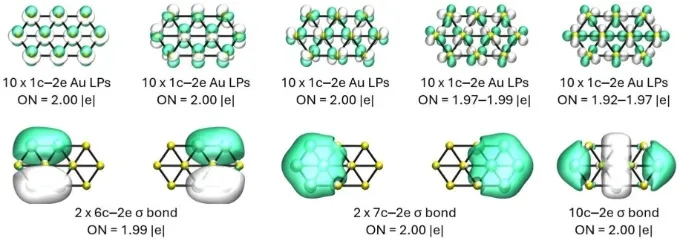
Design and analysis of species with unconventional bonding, such as planar hypercoordinate carbons, molecular stars and tubular boron motifs.
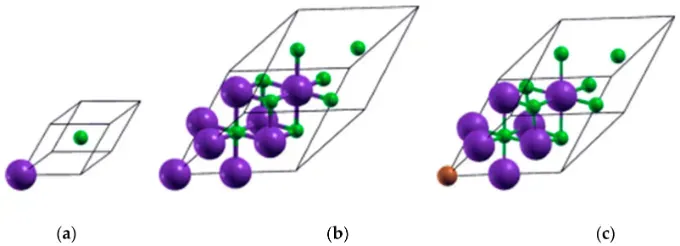
Linear and nonlinear optical response, band structure and thermoelectric properties of solids, surfaces and two-dimensional systems.