Skip to content
CabellosResearch Group
  • Home
  • Research
  • People
  • Publications
  • Notes
  • Gallery
  • Contact us
  • EN
  • ESEspañol
  1. Home
  2. Research areas

Research areas

Our lines share tools and systems: the structures we find feed thermal analysis, bonding studies and spectra prediction.

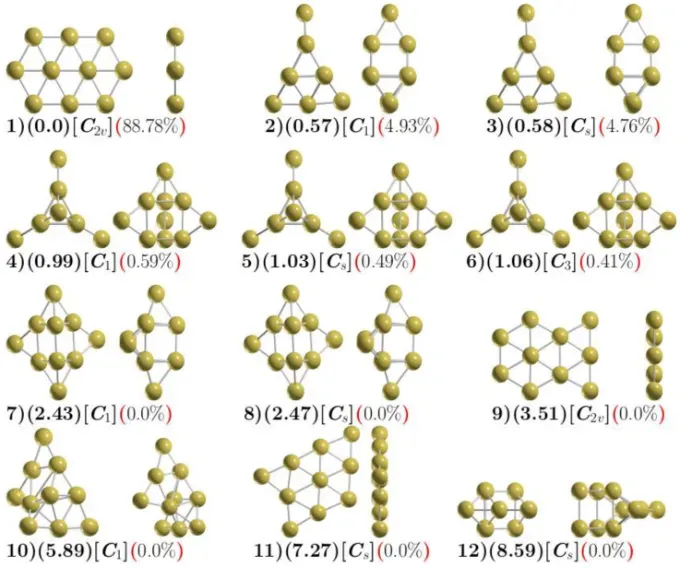
Twelve low-energy isomers of the Au10 nanocluster in front and side view, with relative energy, symmetry and Boltzmann population; the planar C2v isomer dominates at 88.78%.
Low-energy isomers of the Au10 cluster found with global optimization and DFT. Fig. 1 from Rojas-González et al., Molecules (2024). CC BY 4.0

01Area

Cluster structure prediction

Global-minimum searches on the potential energy surfaces of atomic and molecular clusters using evolutionary algorithms coupled to density functional theory.
  • global optimization
  • genetic algorithms
  • GLOMOS
  • DFT
  • nanoclusters
Learn more40 publications
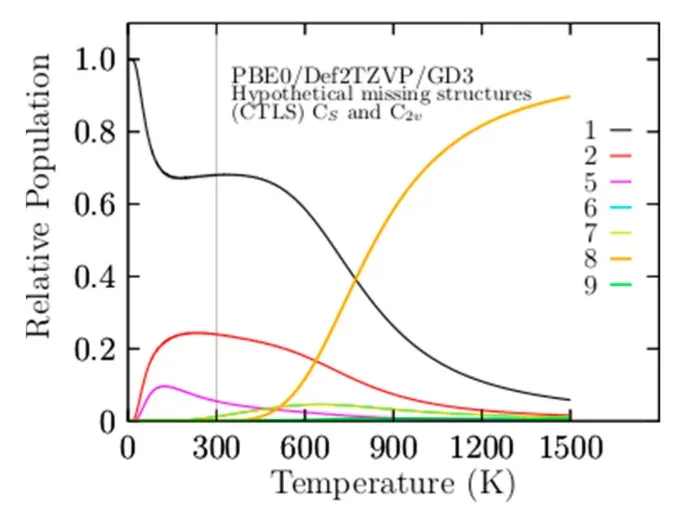
Plot of relative population versus temperature, from 0 to 1500 K, for the isomers of the anionic Be6B11 cluster computed at PBE0/Def2TZVP/GD3; isomer 1 dominates at low temperature and isomer 8 above roughly 800 K.
Boltzmann populations of the Be6B11− isomers between 0 and 1500 K. Fig. 4 from Buelna-Garcia et al., Materials (2020). CC BY 4.0

02Area

Finite-temperature effects and statistical thermodynamics

Free-energy surfaces, Boltzmann populations and temperature-dependent IR and VCD spectra that explain cluster fluxionality and chirality.
  • free energy
  • Boltzmann populations
  • IR spectroscopy
  • VCD
  • fluxionality
Learn more14 publications
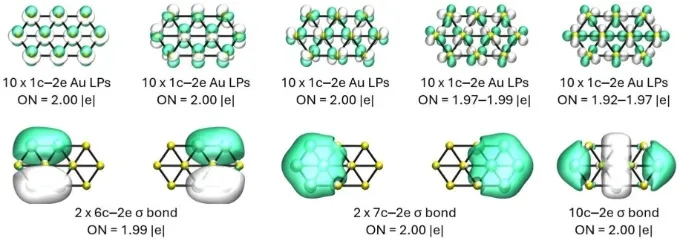
AdNDP analysis of the planar Au10 cluster: one-center two-electron gold lone pairs and delocalized six-, seven- and ten-center sigma bonds, with occupation numbers close to 2.
Chemical bonding in planar Au10: AdNDP analysis with multicenter σ bonds. Fig. 2 from Rojas-González et al., Molecules (2024). CC BY 4.0

03Area

Chemical bonding and aromaticity

Design and analysis of species with unconventional bonding, such as planar hypercoordinate carbons, molecular stars and tubular boron motifs.
  • planar hypercoordinate carbon
  • boron clusters
  • aromaticity
  • reaction mechanisms
Learn more25 publications
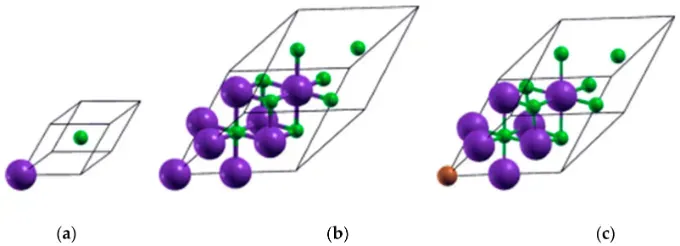
Potassium chloride cells: (a) primitive cell, (b) supercell and (c) supercell with one copper atom replacing a potassium atom.
Pure and Cu-doped KCl cells used to compute unfolded bands and optical response. Fig. 1 from Castillo-Quevedo et al., Materials (2020). CC BY 4.0

04Area

Optical and electronic properties of materials

Linear and nonlinear optical response, band structure and thermoelectric properties of solids, surfaces and two-dimensional systems.

  • second-harmonic generation
  • band structure
  • nonlinear optics
  • thermoelectrics
Learn more25 publications
Cabellos Research Group

Computational Chemistry of Clusters and Materials Group

Universidad Politécnica de Tapachula
Research and Technological Development Office

Contact

  • jose.cabellos@uptapachula.edu.mx
  • 962 465 9908
  • Carretera Tapachula–Puerto Madero km 24 + 300
    30830 Tapachula, Chiapas, Mexico

Sections

  • Home
  • Research
  • People
  • Publications
  • Notes
  • Gallery
  • Contact us

Profiles

  • ORCID (opens external site)
  • Google Scholar (opens external site)
  • Frontiers Loop (opens external site)
  • UPTap (opens external site)

© 2026 Cabellos Research Group. All rights reserved.