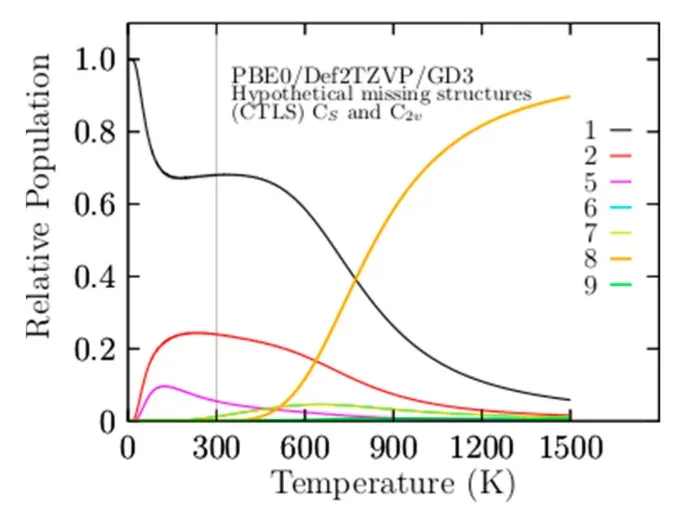
Finite-temperature effects and statistical thermodynamics
Free-energy surfaces, Boltzmann populations and temperature-dependent IR and VCD spectra that explain cluster fluxionality and chirality.
Area 01
Global-minimum searches on the potential energy surfaces of atomic and molecular clusters using evolutionary algorithms coupled to density functional theory.
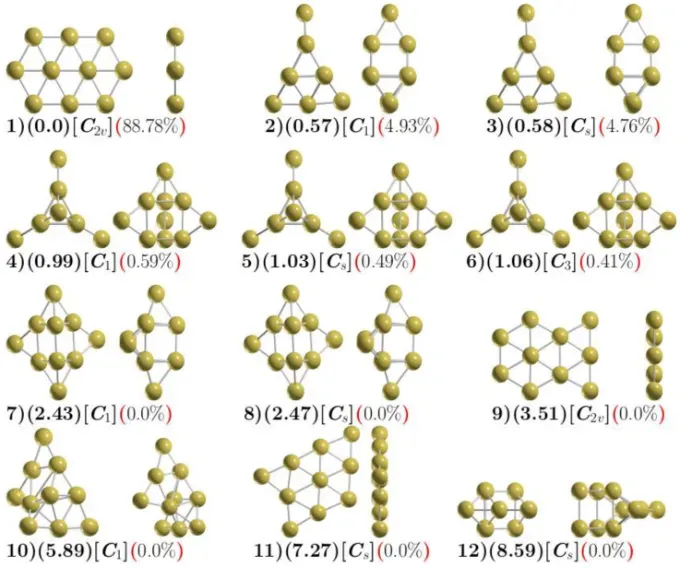
The properties of a cluster depend on its geometry, and the most stable geometry cannot be guessed: the number of possible structures grows exponentially with the number of atoms. This line develops and applies global optimization strategies to locate the global minimum and the low-energy isomers on the potential energy surface.
The group combines evolutionary and genetic algorithms, such as the GLOMOS strategy, with density functional theory (DFT) calculations that include dispersion corrections and, for heavy metals, relativistic effects. Candidates are refined hierarchically until a reliable set of structures is obtained.
These structures are the starting point for the group’s other lines: thermal analysis, bonding studies and spectra prediction.
40 publications
Structure search for B7Mn2 clusters: Inverse sandwich geometry with a high-spin state
Computational and Theoretical Chemistry 1254, 115487 (2025)
Structure- and Size-Dependent Properties of BnCu20/– (n = 2–14) Clusters: DFT Calculations
The Journal of Physical Chemistry A 129(22), 4855–4860 (2025)
An Overview of Subnanostructured Metallic Systems
Surface Review and Letters (2025)Review
Exploration of Free Energy Surface of the Au10 Nanocluster at Finite Temperature
Molecules 29(14), 3374 (2024)
Structures of Ni-doped Bn (n = 1–13) clusters: A computational study
Inorganica Chimica Acta 568, 122062 (2024)
Estudio de la influencia del agua en la citosina mediante métodos DFT
Estudios de la Ciénega(7), 129–152 (2024)
PDF (opens external site)https://revistaestudiosdelacienega.com/ojs/index.php/rec/article/view/101 (opens external site)
Structural and optical properties of the Agn–tyrosine complexes (n = 3−12): a density functional theory study
Royal Society Open Science 10(12), 230908 (2023)
Structure effects of Pt15 clusters for the oxygen reduction reaction: first-principles calculations
Physical Chemistry Chemical Physics 25(6), 4764–4772 (2023)
Effects of Temperature on Enantiomerization Energy and Distribution of Isomers in the Chiral Cu13 Cluster
Prime Archives in Material Science (2022)Chapter
PDF (opens external site)doi:10.37247/pams4ed.4.22.16 (opens external site)
Thermodynamic Properties of Cu38 Cluster
Prime Archives in Chemistry (2022)Chapter
PDF (opens external site)doi:10.37247/pachem2ed.2.22.22 (opens external site)
Relative Populations and IR Spectra of Cu38 Cluster at Finite Temperature Based on DFT and Statistical Thermodynamics Calculations
Frontiers in Chemistry 10, 841964 (2022)
PDF (opens external site)doi:10.3389/fchem.2022.841964 (opens external site)
Boltzmann Populations of the Fluxional Be6B11− and Chiral Be4B8 Clusters at Finite Temperatures Computed by DFT and Statistical Thermodynamics
Density Functional Theory – Recent Advances, New Perspectives and Applications (IntechOpen) (2022)Chapter
Effects of Temperature on Enantiomerization Energy and Distribution of Isomers in the Chiral Cu13 Cluster
Molecules 26(18), 5710 (2021)
Effects of Temperature on IR Spectroscopy of the Fluxional Be6B11− Cluster
Prime Archives in Material Science (2021)Chapter
PDF (opens external site)doi:10.37247/pams2ed.2.2021.25 (opens external site)
Theoretical Prediction of Structures, Vibrational Circular Dichroism, and Infrared Spectra of Chiral Be4B8 Cluster at Different Temperatures
Molecules 26(13), 3953 (2021)
Effects of van der Waals interactions on the structure and stability of Cu8−xPdx (x = 0, 4, 8) cluster isomers
Materials Today Communications 26, 102024 (2021)
Exploration of Free Energy Surface of Chiral Be4B8 Cluster at Different Temperatures
Prime Archives in Material Science (2021)Chapter
Exploration of Free Energy Surface and Thermal Effects on Relative Population and Infrared Spectrum of the Be6B11− Fluxional Cluster
Materials 14(1), 112 (2020)
GLOMOS: An efficient global search toolkit for complex molecular systems
Conference abstract (Morressier) (2020)Conference
doi:10.26226/morressier.5f6c5f439b74b699bf390ae3 (opens external site)
Li2B24: the simplest combination for a three-ring boron tube
Nanoscale 11(5), 2143–2147 (2019)
Theoretical investigation of the structures of unsupported 38-atom CuPt clusters
The European Physical Journal B 91(6) (2018)
Structure and Bonding in CE5− (E = Al–Tl) Clusters: Planar Tetracoordinate Carbon versus Pentacoordinate Carbon
Chemistry – An Asian Journal 13(11), 1467–1473 (2018)
Li2B12 and Li3B12: Prediction of the Smallest Tubular and Cage-like Boron Structures
Angewandte Chemie International Edition 57(17), 4627–4631 (2018)
GLOMOS 1.0
Cinvestav Mérida (2018)Software
Structural Evolution of the Rhodium-Doped Silver Clusters AgnRh (n ≤ 15) and Their Reactivity toward NO
The Journal of Physical Chemistry C 121(35), 19420–19427 (2017)
Coaxial Triple-Layered versus Helical Be6B11− Clusters: Dual Structural Fluxionality and Multifold Aromaticity
Angewandte Chemie International Edition 56(34), 10174–10177 (2017)
E3M3+ (E = C–Pb, M = Li–Cs) Clusters: The Smallest Molecular Stars
Chemistry – A European Journal 23(47), 11430–11436 (2017)
Dynamical behavior of boron clusters
Nanoscale 8(40), 17639–17644 (2016)
Structure and bonding in WCn (n = 2–5) clusters
Theoretical Chemistry Accounts 135(9) (2016)
Microsolvation of NO3−: structural exploration and bonding analysis
RSC Advances 6(76), 71913–71923 (2016)
Structural and Electronic Properties of Ruthenium-Doped Germanium Clusters
The Journal of Physical Chemistry C 120(15), 8399–8404 (2016)
How Many Water Molecules Does it Take to Dissociate HCl?
Chemistry – A European Journal 22(8), 2812–2818 (2016)
Estudio teórico de la microsolvatación del cis-diaminodicloroplatino(II)
Revista del Centro de Graduados e Investigación, 163 (2016)Conference
Dynamical behavior of Borospherene: A Nanobubble
Scientific Reports 5, 11287 (2015)
PDF (opens external site)doi:10.1038/srep11287 (opens external site)
Planar tetracoordinate carbons with a double bond in CAl3E clusters
Physical Chemistry Chemical Physics 17(14), 8769–8775 (2015)
The rich and complex potential energy surface of the ethanol dimer
Theoretical Chemistry Accounts 134(2) (2015)
Structural evolution of small gold clusters doped by one and two boron atoms
Journal of Computational Chemistry 35(32), 2288–2296 (2014)
Ab Initio Study on the Stability of NgnBe2N2, NgnBe3N2 and NgBeSiN2 Clusters
ChemPhysChem 15(12), 2618–2625 (2014)
Exploring the Potential Energy Surface of E2P4 Clusters (E = Group 13 Element): The Quest for Inverse Carbon-Free Sandwiches
Chemistry – A European Journal 20(16), 4583–4590 (2014)
Potential Energy Surfaces of WC6 Clusters in Different Spin States
The Journal of Physical Chemistry A 118(31), 5762–5768 (2014)
Free-energy surfaces, Boltzmann populations and temperature-dependent IR and VCD spectra that explain cluster fluxionality and chirality.
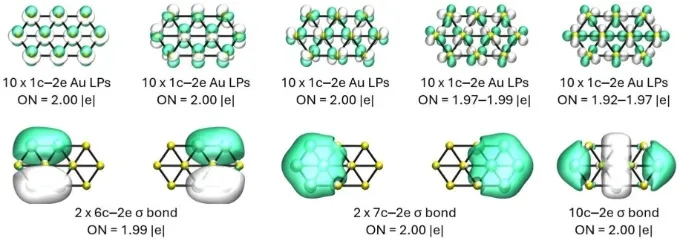
Design and analysis of species with unconventional bonding, such as planar hypercoordinate carbons, molecular stars and tubular boron motifs.
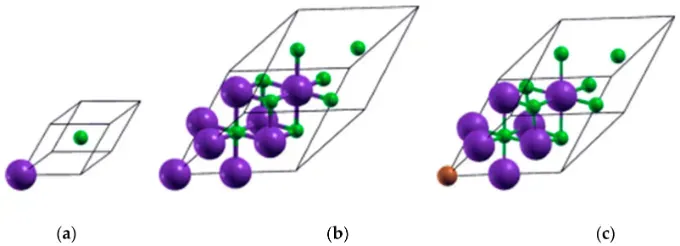
Linear and nonlinear optical response, band structure and thermoelectric properties of solids, surfaces and two-dimensional systems.